ASHISH MUKHERJEE
Bespoke Atelier | Lajpat Nagar 2, New Delhi
Indo-Dhoti in Lajpat Nagar, South Delhi
India’s Oldest Garment, Reimagined for South Delhi’s Most Discerning Men
By Ashish Mukherjee
Keywords: Indo Dhoti Lajpat Nagar | Indo Dhoti South Delhi | Dhoti Kurta Delhi NCR | Bespoke Dhoti Delhi | Dhoti Pants Lajpat Nagar | Designer Indo-Western Dhoti Delhi | Custom Dhoti Tailor South Delhi | Dhoti for Wedding Delhi NCR
Before there was a suit, before there was a sherwani, before there was a kurta — there was the dhoti. It is India’s oldest surviving garment. A rectangle of cloth, wrapped with precision, worn with dignity, and carrying within its unstitched folds the entire civilisational memory of a subcontinent. And at my atelier in Lajpat Nagar 2, I have spent two decades watching it reclaim its position at the very apex of South Delhi’s most refined wardrobes — transformed, through the hands of a bespoke tailor, into what we now call the Indo-Dhoti: a garment that is simultaneously the oldest and the most contemporary thing a South Delhi man can wear.
The Dhoti: A 4,000-Year Journey from the Indus Valley to South Delhi
The dhoti is not merely a garment. It is a civilisational document. The earliest evidence of dhoti-wearing on the Indian subcontinent dates to the Indus Valley Civilisation, which flourished from approximately 2600 BCE to 1900 BCE in the region that is now Northwest India and Pakistan. Terra cotta figurines from Mohenjo-daro and Harappa show male figures in draped lower garments remarkably similar to the dhoti as we know it today. The garment has, in other words, outlasted empires, survived invasions, endured colonial attempts to replace it, and arrived in the 21st century as vital and as relevant as it has ever been.
In the Vedic era, the dhoti — then called the antariya — was the principal garment of Indian men across social classes. Priests wore it in white cotton as a symbol of purity. Kings wore it in silk with gold zari borders as a declaration of sovereignty. Warriors wore it tucked high for freedom of movement in battle. The garment’s genius was always this: the same rectangle of cloth could signal every register of Indian social life, from the most sacred to the most martial, simply through the manner of its draping.
Through the Mauryan Empire (322–185 BCE), the Gupta period (3rd to 6th century CE), and into the medieval Rajput kingdoms, the dhoti remained the foundational garment of Indian masculine identity. Sculpture from Sanchi, Ajanta, Ellora, and Khajuraho shows the dhoti worn with extraordinary variety — long, short, pleated, smooth, tucked between the legs in the ‘kachcha’ style of farmers and warriors, or falling freely in the ‘soca’ style of scholars and priests.
The Mughal period brought the kurta-pyjama from Persia and Central Asia, and urban India began a slow drift from the dhoti toward stitched garments. The British colonial era accelerated this drift in cities, where men in dhotis were systematically excluded from colonial professional and social spaces. This is the period’s single most telling detail about the dhoti’s cultural power: the colonial administration understood, implicitly, that a man who wore the dhoti with confidence was a man who had not accepted the terms of their authority.
After independence in 1947, the dhoti experienced both decline and resilience simultaneously. Mahatma Gandhi’s deliberate choice of the dhoti as his political uniform — worn topless, in the coarsest khadi, in a direct visual rebuke to British suits and Savile Row tailoring — had elevated it to a symbol of national dignity that it retains to this day. And in South India, particularly in Tamil Nadu, Kerala, Andhra Pradesh and Karnataka, the dhoti — in its regional forms of the veshti, mundu, and pancha — never lost its prominence as formal wear for every class of society.
What Is the Indo-Dhoti? The Bespoke Interpretation at Lajpat Nagar
The ‘Indo-Dhoti’ as I create it at my Lajpat Nagar atelier is a deliberate synthesis of this ancient tradition with the contemporary needs and aesthetic sensibilities of South Delhi’s most discerning clientele. It is not one garment but a philosophy of dressing — the recognition that the dhoti’s draped wisdom can be expressed in multiple forms, each suited to different occasions and different registers of formality.
1. The Traditional Bespoke Dhoti: Draped and Delivered
For clients who wish to wear the dhoti in its classical form — draped, unstitched, in the full tradition of Indian formal wear — I source and supply fine quality dhotis in handwoven cotton, silk, and cotton-silk blends, with borders in gold zari, silver, or contrasting colour. I pair these with bespoke kurtas, Bandhgala jackets, or structured angrakha-inspired upper garments that give the traditional drape a contemporary visual frame. The result is a man dressed in the full authority of Indian heritage without a single compromise on quality or fit.
2. The Dhoti Pant: The Stitched Interpretation
For clients who prefer the ease of stitched construction, the Dhoti Pant is a tailored trouser built to replicate the silhouette of the draped dhoti. It features generous pleats at the front waist that open into a wide, flowing leg; a structured waistband with a clean hook-and-eye closure; and a hem that falls at the ankle with either a straight finish or a subtle gathering cuff. The Dhoti Pant at Ashish Mukherjee’s studio is made to your exact measurements, with the pleat volume and leg width calibrated to your height and build. It is worn with kurtas, Bandhgalas, or even a structured western shirt for the most adventurous Indo-Western interpretation.
3. The Indo-Western Dhoti Combination
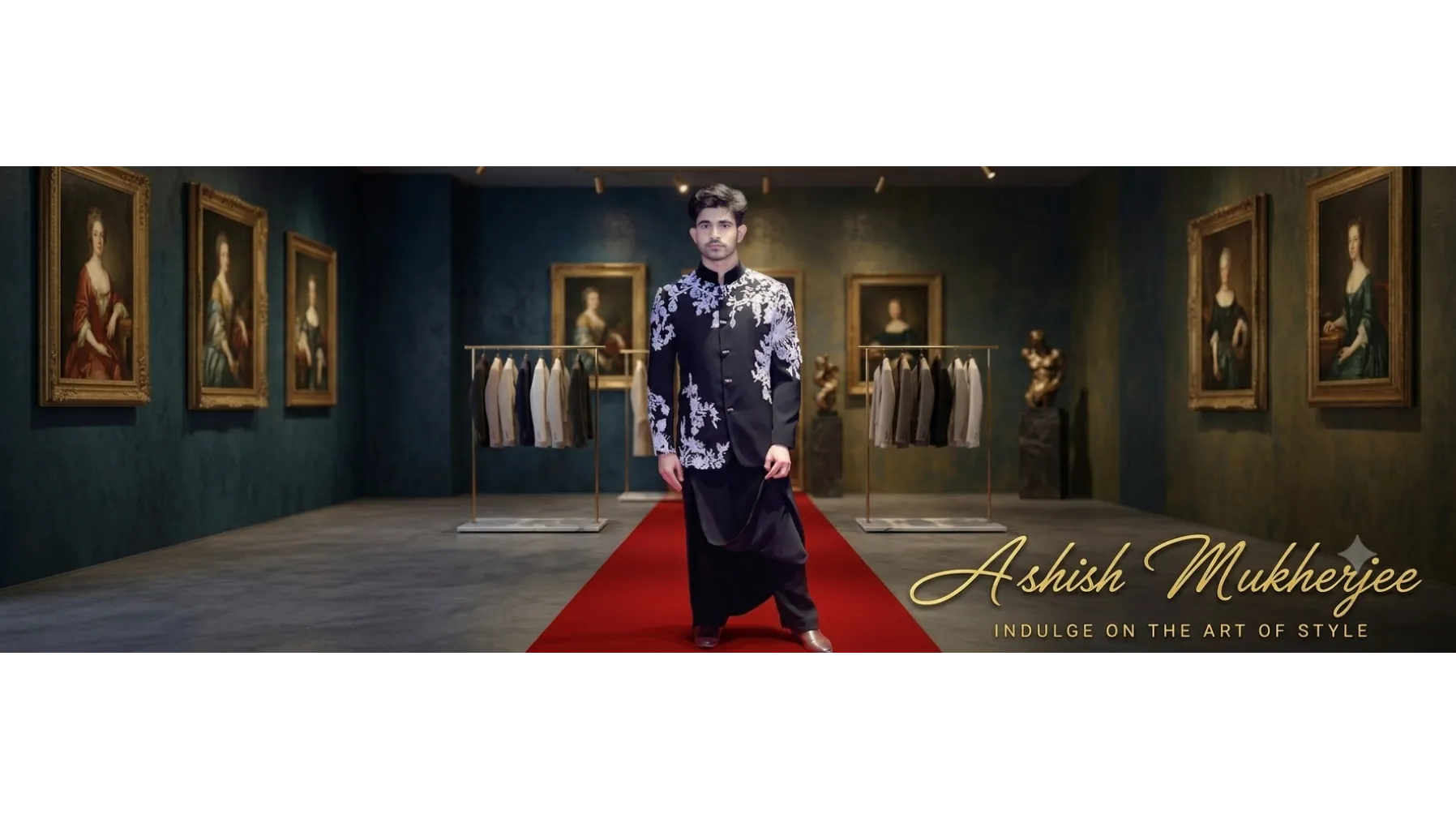
Perhaps the most exciting interpretation: a kurta-Bandhgala or structured jacket top paired with a dhoti or dhoti pant in a contrasting or tonal fabric, creating a look that is entirely at home in South Delhi’s most culturally hybrid spaces. The upper body speaks one vocabulary; the lower body another; and the combination, at the level of bespoke craftsmanship, is a completely coherent statement of personal identity. This is the Indo-Dhoti at its most South Delhi.
Why the High-Profile South Delhi Man Is Returning to the Dhoti
There is something deeply significant happening in the wardrobes of South Delhi’s most powerful and culturally aware men. After decades in which the dhoti was seen as either ceremonial wear (for religious occasions only) or the preserve of older generations, a new generation of men — in their thirties, forties, and fifties — is reclaiming it with full intention.
Partly, this is the global conversation about cultural reclamation: the recognition that garments with deep roots in one’s own civilisation carry a dignity that no borrowed silhouette can match. Partly, it is the increasing discomfort with the Western suit as the default of professional Indian life — a garment imported from a different climate, culture, and tradition that Indian men have been wearing at considerable physical and cultural cost for over a century.
And partly, it is simply the realisation that the dhoti, worn well, with the right upper garment and the right fabric, is one of the most visually powerful things an Indian man can wear. There is a reason it dressed every king, every sage, every warrior, and every artist this civilisation has produced. The wisdom is not in the cloth. It is in the drape.
Key Benefits of the Indo-Dhoti
• Deepest Cultural Authority: No garment signals Indian civilisational confidence more completely than the dhoti worn with intention. For the South Delhi man who wishes to make a statement of identity — not fashion, identity — the Indo-Dhoti is without equal.
• Exceptional Climate Suitability: The dhoti’s traditional form is one of the most breathable, comfortable lower-body garments ever developed — designed specifically for the Indian subcontinent’s heat and humidity. In the warmest months of Delhi’s calendar, a fine cotton or Chanderi dhoti is significantly more comfortable than any trouser.
• Infinite Fabric Range: From the coarsest khadi (carrying Gandhian symbolism) to the finest Kanchipuram silk (carrying royal South Indian heritage), the dhoti can be made in virtually any Indian textile tradition. Each fabric tells a different story; each occasion deserves its own fabric choice.
• Singular Visual Impact: In a room full of suits and sherwanis, a man in a beautifully made Indo-Dhoti combination is unmistakable. The silhouette is entirely his own. There is no mass-market equivalent, no retail approximation. It can only be made — and made well — by a craftsman with deep knowledge of this tradition.
• Heritage Storytelling: The dhoti connects the man who wears it to a 4,000-year continuum of Indian masculine elegance. For the South Delhi client who understands that the most powerful accessory is a story, the Indo-Dhoti is unmatched.
The Ashish Mukherjee Process: The Indo-Dhoti at Lajpat Nagar
Every Indo-Dhoti consultation at my studio begins with a conversation about the occasion. Is this a family wedding at a farmhouse in Mehrauli? A cultural evening in Lodhi Colony? A private pooja in a South Delhi home? A destination wedding in Rajasthan? The occasion determines the fabric, the drape style, the upper garment pairing, and the accessories I recommend.
For clients choosing the stitched Dhoti Pant form, we take full measurements: waist, hip, thigh circumference, inseam, and crucially the stance and posture of how the client stands and moves. The pleat volume, leg width, and hem fall are all calculated from these measurements. For clients choosing the traditional draped dhoti, I supply the cloth from my textile sources and provide guidance on the draping style best suited to the occasion and the client’s physique.
The upper garment — kurta, Bandhgala, or Indo-Western structured top — is made in coordination, ensuring that the proportion between upper and lower garment is calibrated for the individual client. No single formula works for every body; every combination is bespoke in the truest sense.
Styling Guide: Indo-Dhoti for the South Delhi Calendar
 Occasion Fabri Styling Note
Frequently Asked Questions
Q: What is the difference between a dhoti and a lungi pant?
The traditional dhoti is an unstitched rectangle of cloth, draped around the lower body in a specific way that resembles trousers. A Lungi Pant is a stitched trouser designed to recreate the silhouette of a wrapped lungi (a close relative of the dhoti, typically shorter and more casually draped). At my atelier, I offer both the traditional draped dhoti, the stitched Dhoti Pant, and the Lungi Pant — and advise clients on which form best suits their occasion and comfort.
Q: Can a dhoti be worn for contemporary formal occasions in South Delhi, or is it only for religious ceremonies?
The dhoti is entirely appropriate for contemporary formal occasions in South Delhi — weddings, reception dinners, cultural events, private celebrations, and even certain professional gatherings where Indian cultural identity is being celebrated. The key is the quality of the cloth, the precision of the drape or cut, and the sophistication of the upper garment pairing. At my atelier, I have made Indo-Dhoti combinations for clients at Bollywood events, corporate felicitations, and diplomatic receptions.
Q: What fabrics are best for a dhoti or dhoti pant in Delhi?
For summer months (April to September): fine handloom cotton, Chanderi cotton-silk, Maheshwari cotton, and Khadi. These breathe beautifully in Delhi’s heat. For winter months and evening events: dupion silk, Banarasi weaves, and Kanchipuram silk for traditional dhotis; fine wool-cotton blends for Dhoti Pants. Fabric choice also depends on the occasion — a wedding demands a more luxurious cloth than a cultural afternoon.
Q: I am in my forties and have never worn a dhoti before. Is it too late to start?
The dhoti is arguably most powerful on a man who has fully grown into himself — which typically means the forties, fifties, and beyond. Many of my most dedicated Indo-Dhoti clients began wearing it in their forties and describe it as one of the most significant wardrobe decisions of their lives. I guide every first-time client through fabric selection, draping instruction (for the traditional form), and occasion appropriateness. It is never too late.
Q: How do I care for a bespoke dhoti pant or a fine silk dhoti?
Fine silk dhotis should be dry-cleaned after each wearing and stored in a muslin or cotton bag, away from direct sunlight. Handloom cotton dhotis can be hand-washed in cold water with a mild detergent. Bespoke Dhoti Pants in linen or cotton should be dry-cleaned for the first several washings to maintain the pleat structure; after that, careful hand-washing or gentle machine washing on a delicate cycle is acceptable. I provide detailed care guidance with every garment.
Q: How far in advance should I book an Indo-Dhoti consultation at your Lajpat Nagar atelier?
For a full Indo-Dhoti combination — upper garment and lower garment together — I recommend booking 4 to 6 weeks before your occasion. This allows for measurement, fabric sourcing, construction, and at least one fitting session. For traditional draped dhotis supplied without construction, 2 to 3 weeks is usually sufficient.
Q: Can you make an Indo-Dhoti set for a groom?
Yes — and this is among the most meaningful commissions I receive. A bespoke Indo-Dhoti bridal set, whether in ivory and gold silk for a traditional North Indian ceremony or in ivory handloom cotton with a Bandhgala for a more contemporary reception, is a deeply personal and distinguished choice for the South Delhi groom. I work directly with the groom on every detail, from fabric to drape style to accessory coordination.
Visit the Atelier
Shop No. B-7, Near Axis Bank & Metro Gate No. 1, Lajpat Nagar 2, New Delhi 110024
Call / WhatsApp: +91 98182 52681 | 08048034386
Email: ashishmukherjee73@gmail.com | www.ashishmukherjee.com
“The dhoti was never simple. It was always sacred, sensuous, and sovereign. Come, and let us dress you in that legacy.”
Related Reading: Bandhgala with Lungi Pant South Delhi | Co-Ord Shirt Set Lajpat Nagar | Bespoke Sherwani Delhi NCR | Coat Cut Shirt Hunter Jacket Delhi
Keywords