ASHISH MUKHERJEE
Bespoke Atelier | Lajpat Nagar 2, New Delhi
The Bespoke Sherwani in South Delhi
Why the Sherwani Made at Lajpat Nagar Is the Only One Worth Wearing
By Ashish Mukherjee
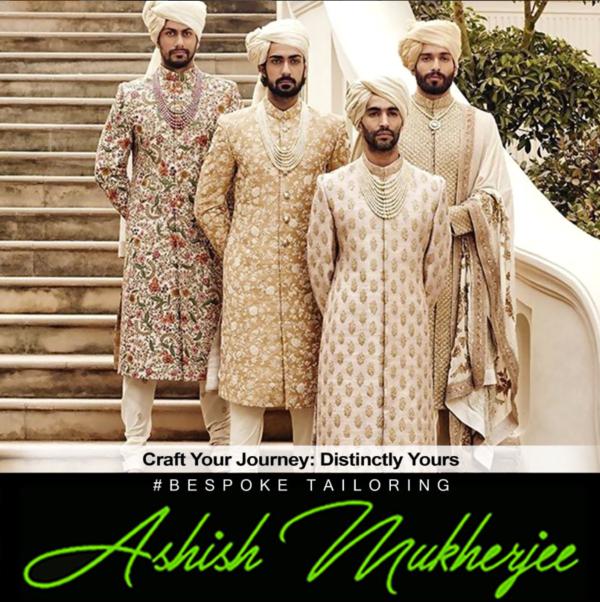
Most men who come to my atelier in Lajpat Nagar 2 for a sherwani arrive having already seen hundreds of them. On mannequins at mall boutiques, on acquaintances at weddings, on Bollywood actors at award nights, on the carefully curated pages of bridal fashion magazines. They have seen the sherwani everywhere. What they have not yet seen is one made precisely for them — in a fabric chosen for their skin tone, an embroidery level calibrated to the occasion, and a silhouette drafted from their exact measurements rather than a standard-size block pattern.
That is the conversation we begin when a client sits across from me. Not ‘what sherwani do you want’ but ‘what moment are you dressing for, and what do you want that moment to say about you forever’. A bespoke sherwani from my studio in Lajpat Nagar is built to answer that question completely.
The Sherwani’s Origin: A Garment Born from Three Civilisations
The sherwani is one of the most genuinely composite garments in world fashion — and understanding its composition is essential to understanding what makes a truly exceptional one. Its roots reach simultaneously into three distinct civilisational traditions: Persian court dress, Central Asian military tailoring, and Indian subcontinent textile artistry.
The Persian chapkan — a long, fitted coat with a front button closure worn by Turkic and Iranian nobility — arrived in India with the Mughal emperors in the 16th century. Emperor Babur’s court brought with them a sophisticated culture of structured outer coats that were layered over the Indian angarkha, the indigenous wrap-front upper garment of the subcontinent. Over the next two centuries, Mughal court tailors — working in the great ateliers of Delhi, Agra, and Lahore — began synthesising these traditions into something entirely new: longer than the angarkha, more fitted than the chapkan, embellished with the extraordinary embroidery arts of Indian craft tradition.
The sherwani as a distinct, named garment emerged in the early 19th century during the British Raj — specifically, research suggests, first appearing in Lucknow in the 1820s, under the Nawabs of Awadh. These were men of the most refined Indo-Persian sensibility, governing from a court that was simultaneously a centre of classical music, Urdu poetry, chikankari embroidery, and an extraordinary cuisine. Their sherwani was a statement of cultural pride in the face of colonial pressure: we have our own formal dress, our own aesthetic standards, our own definition of what authority looks like, and it is not a British frock coat.
The sherwani absorbed British tailoring precision — structured shoulders, fitted chest, clean button-band — while retaining Indian surface richness: the zardozi gold work, the resham threadwork, the gota patti applique, the Lucknowi chikankari. This synthesis — Western structure, Indian soul — is what makes the sherwani unique among the world’s formal garments. And it is exactly what I recreate, in the most complete form I know how, at my studio in Lajpat Nagar.
What Separates a Truly Bespoke Sherwani from Everything Else
South Delhi’s high-profile clients have, most of them, worn sherwanis before. Many have worn expensive ones — from branded boutiques in Khan Market or Select Citywalk, from well-known wedding wear labels, perhaps from designers they have seen in magazines. Some of those sherwanis were handsome. None of them were made for the man wearing them.
A truly bespoke sherwani — the kind I make at my Lajpat Nagar atelier — begins not with a design but with a conversation. I need to understand: the occasion (baraat, reception, Eid, cultural event); the venue (outdoor farmhouse, five-star hotel, ancestral home); the season (Delhi winter demands different fabrics than Delhi spring); the man’s relationship to this garment (is this his first sherwani, or his tenth?); and what he wishes to communicate when he enters the room in it.
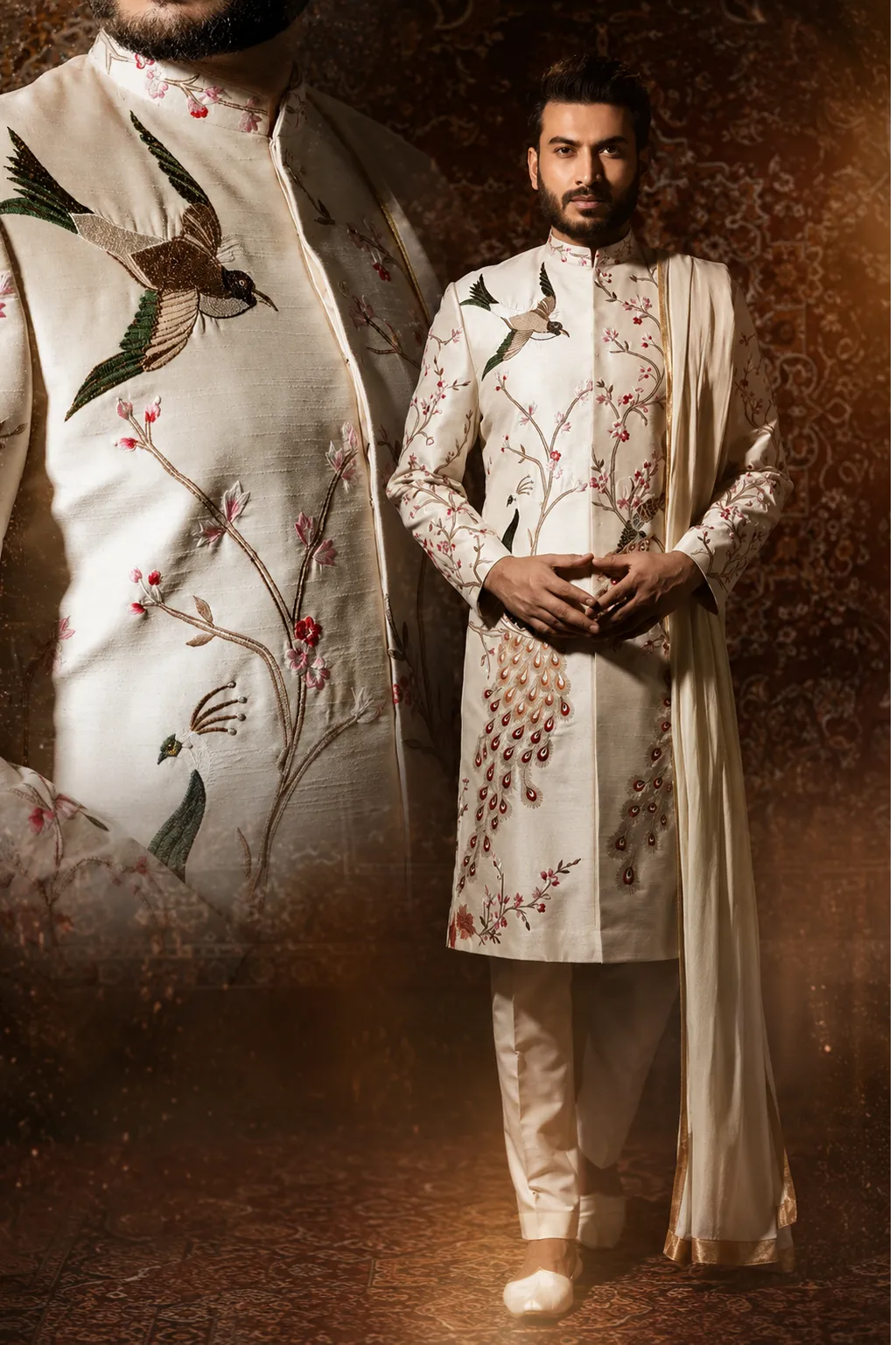
From that conversation, we build the garment together. Not from a catalogue of options, but from first principles: the length (traditional knee-length, or a more contemporary mid-thigh cut?); the collar (high stand, mandarin, or a slight softening of the neck?); the button placement and button material (horn, metal, mother-of-pearl, or custom resin?); the embroidery level (minimal and architectural, or full and celebratory?); the embroidery placement (yoke and cuffs only, or running the full front band?); the lining (silk-lined for winter; unlined for spring); the lower garment (churidar, Jodhpuri breeches, or a contemporary slim trouser?).
Every one of these decisions changes the garment. Together, they produce a sherwani that could not have been made for anyone else.
The Ashish Mukherjee Sherwani: Five Signatures of Craft
• The Collar Construction: The sherwani’s defining feature — its closed, structured neck — must be built with an inner interlining that holds its shape through an entire wedding day of embraces, bows, and photographs. I use hand-pad-stitched canvas interlinings that give the collar its life for the garment’s entire lifespan.
• The Shoulder and Chest: The sherwani’s silhouette depends on how it breaks at the shoulder and falls across the chest. I draft the shoulder seam to sit precisely at the natural shoulder point — not forward, not behind, not padded to cover the difference — and the chest to drape with the clean fullness that the garment requires.
• The Embroidery Sourcing: I work with embroidery artisans from Lucknow (for chikankari), Varanasi (for zari work), and Surat (for zardozi) — craftspeople I have known for years, whose quality I can vouch for completely. I never use machine-embroidered substitutes, regardless of how close the result appears to the eye in a showroom.
• The Fabric Authenticity: My sherwani fabric library includes genuine Banarasi silk-brocades (not polyester imitations), real dupion silks, handloom velvet weaves, and fine cotton-linens for contemporary sherwanis. I show clients the difference under natural light before they choose.
• The Lower Garment Partnership: A sherwani is only as complete as its lower garment. I make the churidar, Jodhpuri trouser, or slim pant alongside the sherwani — in a complementary or matching fabric — ensuring that the proportion between jacket and trouser is as carefully considered as every other element of the garment.
The Sherwani for the South Delhi Groom: A Special Responsibility
The groom’s sherwani occupies a particular place in my work. It is, for most men, the most photographed garment of their life — the one that will appear in albums kept for generations, in framed photographs on living room walls, in the visual memory of every person who attended the wedding. The responsibility of getting it right is absolute.
At my Lajpat Nagar studio, I approach every groom’s sherwani commission with a minimum of three consultation sessions before a thread is cut. The first session is the conversation: occasion, family aesthetic, personal taste, the bride’s look that the sherwani should complement without competing with. The second session is fabric and embroidery selection. The third is the first fitting on the constructed shell, where we confirm length, shoulder, chest, and overall silhouette before the embroidery is applied.
I have made sherwanis for grooms from old South Delhi families with strong aesthetic traditions of their own; for first-generation professionals making the transition from Western formal wear to Indian ceremonial dress for the first time; for younger men who want a sherwani that breaks conventions without losing its authority; and for international grooms of Indian origin who return to Delhi specifically for this commission, understanding that what they will find here is unavailable anywhere else in the world.
Styling Guide: The Bespoke Sherwani for Every Occasion

Frequently Asked Questions
Q: How is a bespoke sherwani from Ashish Mukherjee different from a designer sherwani from a branded boutique?
A branded boutique sherwani is made in standard sizes — small, medium, large, XL — with minor alterations possible at purchase. A bespoke sherwani from my atelier is drafted from your exact measurements, in a fabric and embroidery level chosen specifically for your occasion, and constructed entirely by hand. The result is a garment that fits, moves, and wears entirely differently. There is no comparison in the actual wearing experience.
Q: What is the best fabric for a wedding sherwani in Delhi’s winter season?
For Delhi’s winter wedding season (November to February), I recommend: heavy Banarasi brocade or dupion silk for evening ceremonies and receptions (visually rich, appropriate weight); fine wool-silk blends for outdoor venues where temperature varies; and velvet for grooms who want maximum ceremonial impact at evening events. I advise against linen or cotton-silk blends for winter evenings, as they can feel cold against the skin in Delhi’s December-January temperatures.
Q: How much embroidery is appropriate for a groom’s sherwani?
This depends entirely on the occasion and the individual’s aesthetic. For a baraat, full yoke and front embroidery with cuff work and hem detailing is entirely appropriate — this is the moment for ceremony. For a reception, where the groom often changes, a lighter embroidery level — tone-on-tone thread work on the collar and cuffs — creates elegance without repetition. I guide every groom through this decision based on his specific wedding programme.
Q: Can a sherwani be made in a non-traditional colour?
Absolutely — and some of my most distinguished commissions have been in unconventional colours. Sage green, slate blue, dusty rose, deep burgundy, and off-white have all produced extraordinary results at my studio. Colour choice depends on the man’s skin tone (I advise on this specifically), the season, the venue lighting, and how the sherwani will relate to the bride’s colour palette. The right colour is the one that is true to the man, not the one that is most conventional.
Q: What is the ideal lower garment to pair with a sherwani?
The traditional pairing is a churidar — a close-fitted trouser with gathered fabric at the ankle that creates a clean, long silhouette when worn with the sherwani’s hem at the knee. For a more contemporary look, I also create slim Jodhpuri trousers or tailored straight-cut trousers in a complementary fabric. The choice depends on the sherwani’s formality level and the occasion.
Q: How long does it take to have a bespoke sherwani made at your Lajpat Nagar studio?
For a complete bespoke sherwani — with three consultations, full construction, embroidery sourcing, and two fittings — I require a minimum of 5 to 6 weeks. For wedding sherwanis, I strongly recommend beginning the commission 8 to 10 weeks before the wedding date, to allow for any adjustments to embroidery placement or silhouette after the first fitting.
Q: Do you make sherwanis for wedding guests as well as grooms?
Yes — and a bespoke sherwani for a wedding guest, in a more restrained fabric and embroidery level than the groom’s, is one of the finest choices a South Delhi man can make for a significant wedding. I work with many regular clients who commission a sherwani for every major wedding they attend, understanding that being well-dressed at a friend’s or family member’s wedding is its own form of respect.
Commission Your Sherwani
Shop No. B-7, Near Axis Bank & Metro Gate No. 1, Lajpat Nagar 2, New Delhi 110024
Call / WhatsApp: +91 98182 52681 | 08048034386
Email: ashishmukherjee73@gmail.com | www.ashishmukherjee.com
“A sherwani is not worn once. It is worn for a moment that is remembered forever. Let us build that moment together.”
Related Reading: Kurta Pant Cut Lajpat Nagar | Bandhgala South Delhi | Designer Sherwani for Groom Delhi NCR | Bespoke Wedding Wear Lajpat Nagar
Keywords